
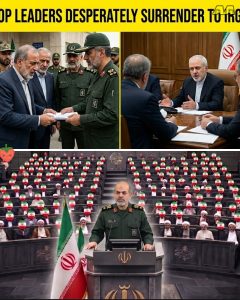
Iran’s Internal Power Struggle Deepens as Military Influence, Economic Collapse, and Failed Peace Talks Push Tehran Toward a Dangerous Breaking Point.
Iran is facing one of the most dramatic internal crises in its modern history, and the world is watching a regime that appears to be breaking from the inside.
What once looked like a tense confrontation with foreign powers has now become something even more dangerous.
It has become a battle inside Tehran itself.
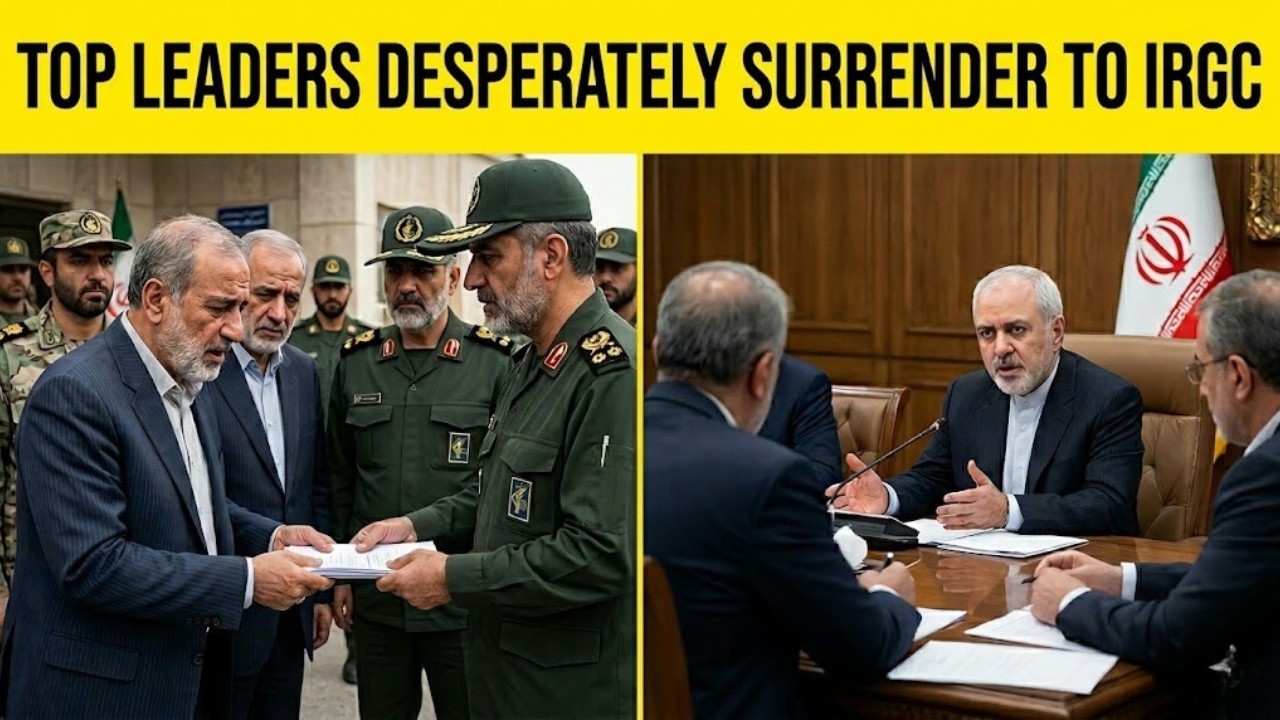
At the center of this crisis is a growing power struggle between Iran’s elected civilian leadership and the Revolutionary Guard commanders who appear to be taking control of the country’s most sensitive decisions.
President Masoud Pezeshkian and Parliament Speaker Mohammad Bagher Ghalibaf are reportedly pushing back against Foreign Minister Abbas Aragchi, accusing him of acting without proper civilian oversight.
That dispute would be serious in any country.
In Iran, it may signal something far more explosive.
The conflict suggests that Iran’s foreign policy is no longer being shaped by elected officials, but by military commanders operating behind the scenes.
According to the claims now circulating, Aragchi has been working closely with senior IRGC figures, especially Ahmad Vahidi, while bypassing the president’s authority.
If true, this means the man responsible for diplomacy may no longer be answering to the civilian government.
He may be answering to the generals.
That is why the crisis has triggered so much alarm.
This is not merely a cabinet disagreement.
It is a struggle over who truly controls the Islamic Republic.
The timing could not be more dangerous.
Iran is already under immense pressure from war, sanctions, economic breakdown, and the continuing crisis around the Strait of Hormuz.
The country is also trying to navigate peace negotiations with the United States while facing deep distrust from Washington.
Yet the basic question now seems almost impossible to answer.
Who is actually speaking for Iran.
Is it the president.
Is it the parliament speaker.
Is it the foreign minister.
Or is it the Revolutionary Guard.
That uncertainty has turned every diplomatic move into a gamble.
A reported 14-point Iranian peace proposal has already been rejected by President Donald Trump, who viewed Tehran’s demands as unrealistic and unacceptable.
The proposal allegedly called for sanctions relief, an end to the naval blockade, reparations, the withdrawal of U.S. forces from the region, and a new mechanism for controlling the Strait of Hormuz.
On paper, it sounded like a sweeping vision for peace.
In practice, it looked like a maximalist document written by a government that may not even agree with itself.
That is the heart of the problem.
A divided state cannot negotiate with confidence.
A government at war with itself cannot convince enemies or allies that any agreement will hold.
The removal of Ghalibaf from the negotiating process reportedly made the situation even worse.
Washington had seen him as one of the few figures who could bridge Iran’s military and civilian power centers.
He had the background, the connections, and the political weight to deliver a deal.
But when he reportedly tried to include the nuclear issue in negotiations, hardliners pushed him aside.
That move sent a chilling message.
Compromise itself may now be treated as betrayal.
The Revolutionary Guard appears determined to control every major lever of power.
It has reportedly influenced key appointments, blocked civilian choices, controlled access to leadership, and shaped national security decisions.
This is how a modern power seizure can happen without tanks in the streets.
It happens through appointments.
It happens through vetoes.
It happens through control of information.
It happens when the president can no longer appoint his own officials without military approval.
For ordinary Iranians, the consequences are devastating.
While elites fight over power, the economy is collapsing around the people.
Inflation is crushing households.
The rial has plunged.
Jobs are disappearing.
Factories are closing.
Food supply chains are under strain.
Internet restrictions have disrupted businesses, families, communication, and daily life.
The crisis is no longer abstract.
It is visible in empty markets, unpaid workers, rising prices, and darkened streets.
Iran’s dependence on trade through the Strait of Hormuz has made the situation even more fragile.
The same waterway once used as leverage has now become a trap.
If Iran cannot safely reopen the strait, its own economy continues to bleed.
If it keeps the strait blocked, global oil markets remain under pressure.
If it backs down, hardliners risk looking weak.
Every option carries danger.
That is why the situation feels like a political pressure cooker.
The government needs peace to survive economically.
The military faction needs confrontation to justify its grip on power.
The people need relief.
The system offers them slogans.
This contradiction may define Iran’s next chapter.
The Revolutionary Guard can control ministries, silence rivals, and shape negotiations.
But it cannot easily control hunger.
It cannot control inflation forever.
It cannot force a collapsing economy to obey military discipline.
And it cannot erase public anger simply by restricting the internet.
The memory of recent protests still hangs over the country.
Millions of Iranians have already shown that frustration is not limited to one city, one class, or one political faction.
The anger is national.
It is economic.
It is political.
It is personal.
People are not only demanding better policies.
They are questioning the entire structure of power.
That is what makes this moment so dangerous for Tehran.
The regime is not facing a single crisis.
It is facing several crises at once.
A legitimacy crisis.
A leadership crisis.
A diplomatic crisis.
A military crisis.
An economic crisis.
Each one feeds the others.
The more the economy collapses, the more the public grows angry.
The more the public grows angry, the more the IRGC tightens control.
The more the IRGC tightens control, the harder diplomacy becomes.
The harder diplomacy becomes, the longer the economic pain continues.
This is the cycle now threatening Iran from within.
For the United States and the wider world, the uncertainty is equally serious.
Negotiating with Tehran has always been difficult.
Negotiating with a Tehran that cannot decide who holds real authority may be almost impossible.
A peace deal signed by one faction could be rejected by another.
A promise made by a diplomat could be blocked by a commander.
A concession accepted by the president could be attacked by hardliners as surrender.
That is why the question of power matters more than any single proposal.
Before the world can know what Iran wants, it must know who has the authority to decide.
Right now, that answer is dangerously unclear.
The image of Iran as a unified state standing against foreign pressure is beginning to crack.
Behind the official speeches, there appears to be confusion.
Behind the calls for unity, there appears to be fear.
Behind the revolutionary slogans, there appears to be a government struggling to control itself.
The irony is brutal.
The Revolutionary Guard was created to protect the Islamic Republic.
Now, its growing dominance may be one of the forces pushing that same system toward collapse.
Iran’s tragedy is that its people are trapped between outside pressure and inside power games.
They are asked to endure hardship in the name of resistance while those in power fight over who gets to command the wreckage.
The coming weeks may determine whether Iran finds a path toward negotiation or sinks deeper into military rule and economic freefall.
One thing is already clear.
The crisis inside Tehran is no longer hidden.
The world is not just watching Iran confront America.
It is watching Iran confront itself.
